

The Art & Craft of Building a Case for Support
Any homeowner would agree that putting on a new roof is more expense than it is excitement. Yet, we all know that a house has to have a reliable roof. So, what do we do when we have leaks? We invest in a new roof. But, if you’re a nonprofit with a tight budget, expenses like that can hit your budget in a way that impacts your ability to meet your mission. So, what do we do? We go out and fundraise for it, often creating a campaign.
Many CapDev clients know that historic buildings come with expensive maintenance demands that are typically not very exciting. Try building a case for support around the need to replace the mortar between the bricks! Even though it can cost millions of dollars, mortar replacement itself is not going to motivate a lot of donor support. So, how does a nonprofit entice supporters to give when a significant element of the campaign is not so sexy?
When the need to raise funds centers around such maintenance needs as a roof, HVAC, window replacements, and other “bricks and mortar needs,” the campaign becomes more about what happens inside that building than the building itself. It is about how enabling the exterior of a building enables the interior in a way that can transform lives and communities because of what can occur in that place, that home.
Let’s work on how we build a strong case for support, using CapDev client, St. Peter’s Episcopal Church in the heart of Charlotte, North Carolina as a case study:
St. Peter’s is preparing to celebrate its 200th anniversary in 2034. In marking the occasion, the parish is not only reflecting on its remarkable history but is also conducting strategic planning that will guide its future. Included in that vision is a recommitment to the important role the church plays in its urban home addressing both present and future needs.
St. Peter’s has planned a $10 million campaign in two phases, the first of which addresses mortar between bricks, and importantly, a whole lot more.
Let’s examine the case development process:
- Build the capital campaigns from the basis of a strategic plan. The objectives of the plan guide the development of the components of the case for support.
St. Peter’s: Building off of their strategic plan, St. Peter’s engaged in a master plan that determined the church’s goals as defined by:
A Shared Conviction that our worship space must be welcoming and accessible to everyone
A Shared Responsibility to care for our historic property
A Shared Desire to nurture and grow programs that define us; specifically music and youth
A Shared Legacy to serve the broader community through outreach and social justice initiatives
- Determine the driving force of the campaign to establish its theme.
St. Peter’s: The theme that emerged was a phrase often repeated in the planning process: “This is our time.” Campaign materials explain the theme in this lovely language:
“People know St. Peter’s Episcopal Church by our open minds and open arms. By our strong voice. By our care for the marginalized. By our sacred, historic home. Most of all, people know us by our love. For almost two centuries, we’ve sought to serve and to be a spark of the divine. We believe that God is always calling us forward, as people and as a parish. The Campaign for St. Peter’s will underwrite the next chapter of needs, hopes and dreams at our beloved church. Let us rise to our particular moment in time while ever more deeply grounded in the eternal.”
- Structure the components of the case and determine anticipated costs. The case needs to make clear the objectives of the campaign and share a sense of cost for each component, demonstrating the need and showing that the organization has done its homework and has a plan to meet the need.
St. Peter’s: The vestry approved a 10-year plan and the first phase of the capital plan to meet the needs determined by the strategic plan. The elements are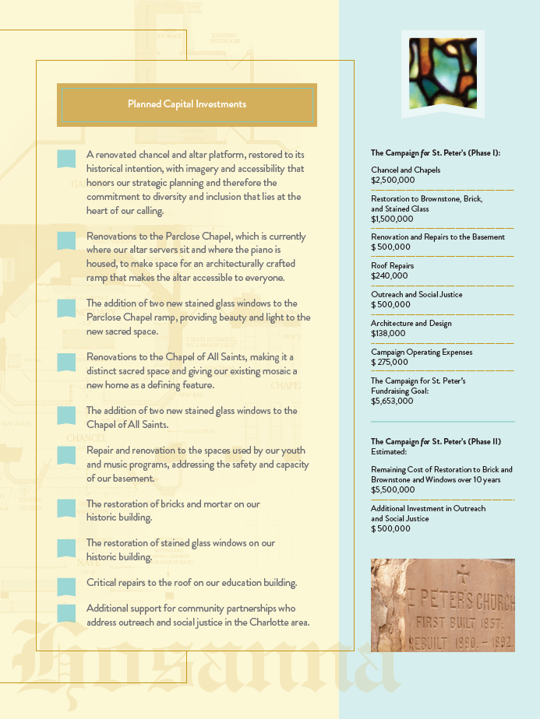 clearly shared in campaign materials:
Phase I:
Chancel and Chapels $2,500,000
Restoration to Brownstone, Brick, and Stained Glass $1,500,000*
Renovation and Repairs to the Basement $ 500,000
Roof Repairs $240,000
Outreach and Social Justice $ 500,000
Architecture and Design $138,000
Campaign Operating Expenses $ 275,000
The Campaign for St. Peter’s Phase I Fundraising Goal: $5,653,000
Phase II:
Remaining Cost of Restoration to Brick and Brownstone and Windows over 10 years $5,500,000*
Additional Investment in Outreach and Social Justice $ 500,000
*Notice the treatment of the brick restoration in both phases of the campaign, buttressed by other significant elements that impact the goals outlined in #1 above.
- Tell the story within the context of the organization’s culture. Know and claim the organization’s identity in such a way that the campaign amplifies its culture.
St. Peter’s: Referencing what the church cares most about in the opening language of its case for support (see #2 above), the campaign is built on the foundation of the parish’s diverse and caring community. This then becomes the basis for investing in the church home that enables that culture. The campaign, therefore, is not about “bricks and mortar;” it is about a church home that is founded in love of God and love of community. A history, selected Biblical verses, and prayers are also shared, lending further context to the church’s culture.
- Appeal to donors with storytelling and facts. Stories sell. Statistics tell. A good case combines both but always lead with the story. People resonate more with a good story than they do with a bunch of numbers.
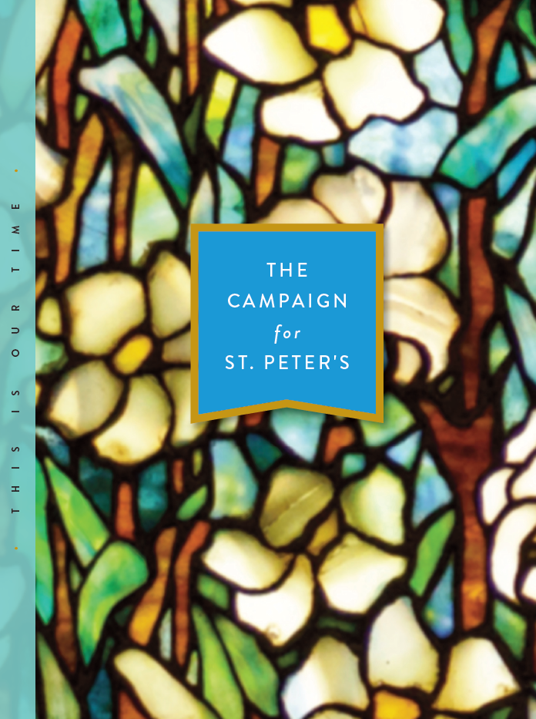
St. Peter’s: Art and photography is a method of storytelling. In the church’s printed case materials, images provide visual appeal for the renovations and photos give a sense of the people who make the church feel like home. Facts are clearly laid out, providing explanations of the campaign’s objectives as solutions to issues the parish faces. A back pocket in the campaign materials folder includes essentials such as a personalized letter, the list of campaign leaders, FAQs, giving levels, ways to give, floorplans, a pledge card and envelope, and even a bookmark made with a colorful image of the church’s stained glass.
- Set out a clear timeline. Large campaign goals often need to be divided into manageable chunks to make it achievable and to ensure success. Sharing the timeline provides transparency and accountability for making the campaign’s plans a reality.
St. Peter’s: The work of campaign planning made it apparent that dividing the $10 million goal into two phases was the best route to success. As of this writing, the church is currently over $4 million toward its first phase $5.6 million goal.
- Make it easy to respond. Every case for support must have a call to action and a response mechanism – printed and digital. Make certain it is clear and functional and that contact information (phone and email) is always readily available.
St. Peter’s: Campaign materials offer a “Call and Response” section, appropriate language for a church campaign. There is a button on the campaign website directing parishioners to give online or download a pledge form.
- Test the case for support. Some organizations want the assurance of a feasibility study, and they use that structure to test their case with donors more formally. Many do not use a study, and are able to test the components of the campaign and their costs in other formats through discussions with critical supporters. Either way, it is important to gain the benefit of outside eyes on a draft case for support before going to print.
St. Peter’s: Because the church had a dedicated process of engaging parishioners in the development of the strategic plan, the master plan, and the campaign planning, the leadership determined that a feasibility study was not necessary. The draft case was shared and tested among groups of leaders who were involved in campaign planning to reach consensus in its development.
- Share the case in campaign materials. Communications is a large and ever-expanding part of campaigns. Printed materials alone are not enough. Donors expect to find your campaign information on your website, hear about it on your social media, receive email updates, mailed and emailed newsletters, and even get thank you letters and calls as gifts are stewarded. Most important is that nonprofits make it easy for those who want to give to reach you, and to make their gift in the easy and secure manner of their choice.
St. Peter’s: Visit the campaign website and contact Allison Elrod, Director of Stewardship, if you’d like to know more about the development and sharing of the beautiful case for support of St. Peter’s Episcopal Church.
In the end, developing the case for support is both an art and a craft. Storytelling is an art that pulls at the heartstrings, compelling generosity. Crafting strong messaging invokes vision and involves leaders. The bottom-line result is an enticing engagement in marrying the mission of the campaign with a potential supporter’s philanthropic drive.
At its core though, a case is just the beginning. It takes the dedication of committed and passionate leaders to share the story of your case with those who will make the vision of the campaign a reality.
Post-Publication Note:
St. Peter’s Episcopal Church recognizes the critical nature of parish-wide communications as the project progresses, and has launched a blog, accessible from their website, with updates on the project status. It began with a letter from the Rector, and is a nice example of campaign stewardship:
https://st-peters.org/an-update-on-the-campaign-for-st-peters/