

Puzzling Lessons
By Clare Jordan
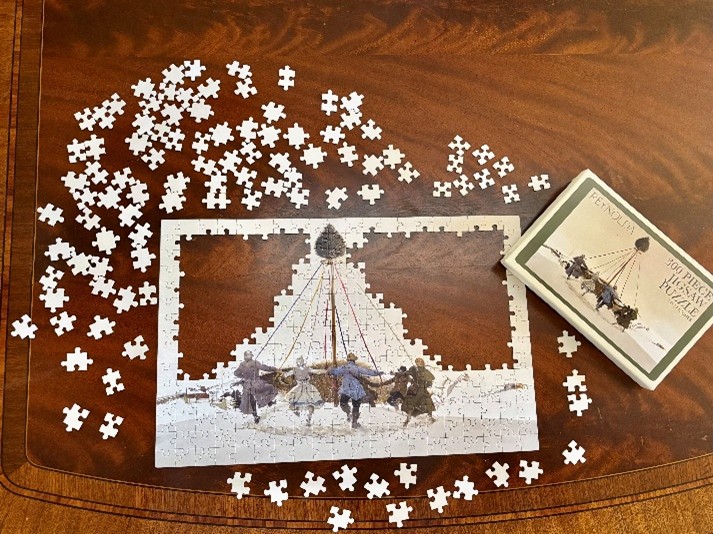
How often do you find yourself working puzzles and thinking of life metaphors that go along with the puzzling process? Call me nerdy, but it occurred to me over the holidays, as I attempted this challenging puzzle with some friends, that there are several lessons for nonprofits in the art of doing puzzles:
1. Start by assessing. Examine closely, sort and organize. Most puzzlers have their own methods. I typically start with sorting out edges and color groups and try to piece together all the edges first. In nonprofit work, we start our engagements with a situational analysis and sometimes a deeper assessment to inform our recommendations. The organizational process of both puzzling and consulting is a critical first step. Before you jump into the 17th annual of your next event, assess it first and determine if it is worth the time or if it needs a new life.
2. Work with a goal in mind. I like to limit my puzzles to 500 pieces, and in nonprofit work it is also important not to take on too much. We don’t work well when we are overwhelmed. Consider ways to lighten your load, such as engaging board members and volunteers, using subcontractors like grant writers and consultants, and delegating projects to junior staffers who could be inspired by the opportunity.
3. Work in phases. Stepping back occasionally really helps put things in perspective. When I step away from a puzzle or from a challenging project, and return to it, I often see things right in front of me that I was missing when I was more bogged down by the work. Just like you can’t cram the pieces in where we want them, we sometimes need to chunk a project up into phases, so it is more manageable and we don’t find ourselves trying to force it when it’s not working.
4. Work with partners. To stay on task, it helps me to puzzle with a buddy or two. Too many working in the same area and we can get in each other’s way, so just like nonprofit work, we need to clearly designate our roles and projects. That said, sometimes we need to reach over someone else’s arm to put in a newly discovered piece, and those moments of new ideas are worth interrupting a project. Working with a smooth-running, committed team builds your capacity to do better work.
5. Stay mission-focused. There is nothing wrong with looking at the picture of your puzzle over and over as you work. It is like the concept of keeping your mission statement posted in front of staff and board at all times, so that we are constantly guided by that vision. Studying the picture closely reminds us that details matter and it helps to refer back to it often. When things are uncertain, refer to that mission and vision statement for reinforcement of your goal and purpose.
6. Recharge as needed. Taking a break is as important to success in completing a puzzle as it is in nonprofit work. That’s why there are sabbaticals. Even if you can’t swing a big break, incorporate time to reset throughout the week —Take a screen-free snack break, go for a walk, or eat lunch away from your desk. Think of all the ways you need sustenance and don’t ignore your body’s pleas.
7. Diversity matters. Just like we all have varying talents, skills, backgrounds, and perspectives that make us unique, each puzzle piece has a shape, size, and color combination unlike any other in the set. Understanding how these characteristics work to determine puzzle placement is a critical skill in puzzling and not to be ignored. When you work to fill staffing vacancies, remember that, like completing a puzzle, multiple factors determine a good fit. In our executive search work, I like to say that even more important than a good cultural fit for a nonprofit, is finding candidates who can make a strong contribution to advance the organization.
Final lesson: Nonprofit work is often a puzzle—sometimes the open spaces take the longest, but breakthroughs are possible when we remember to revisit the big picture, take breaks, and enlist the help and fresh perspective of trusted partners along the way. As for me, I will choose a puzzle with less white space next time!
Return to Insights & Events