


Recipe for Campaign Planning
By Clare Jordan
Like baking a cake, it helps to have a guide in planning a major campaign. The instructions in the campaign recipe have been proven in the test kitchens of thousands of nonprofit organizations. As in baking, alterations can improve the cake or ruin it, so read this recipe and decide how you want to model it for your campaign:
Ingredients:
1 large vision
½ audience + ½ case writing
1000s of words in messaging
7 ways of sharing your story
3 phases (or more) in your campaign timeline
$$ in your budget
1+ campaign chairs
Seasoned blend of staffers
Dozens of data points to analyze
Dash of patience
Instructions:
1. Engage the board and key leaders in determining the vision for the campaign.
- If capital, determine specific project plans, priorities, and costs
- If endowment, determine funds to support and amounts needed
2. Identify your product (for what are you raising money?) and your audience (who will support this cause with major gifts?). Start drafting your case for support around your defined purpose.
3. Develop messaging with the perspective of your major donor audience in mind, addressing these key ABC questions:
- Audience: For whom am I writing?
- Benefit: Why should they care? What makes this project important?
- Call-to-Action: What do I want them to do about it?
4. It is often said that someone needs to encounter your appeal in seven different ways. Share your story using the “7 C’s of effective communication” to be:
- Clear
- Concise
- Concrete
- Correct
- Coherent
- Complete
- Courteous
Also consider a variety of channels and methods used to convey your messaging:
- Verbal communication – meet with donors in person as much as possible and make calls to request a meeting
- Written communication – creating campaign materials that are shared by email, digitally, and in printed materials, including customized proposals with personalized messaging in letters, emails, etc.
- Visual communication – using images, graphics, videos, especially in social media and in preparing presentations
- Listening – don’t leave out the active process of receiving and interpreting spoken messages by listening carefully to potential supporters
- Feedback – remember the process where donors acknowledge their understanding of your case and respond to it, completing the communication loop
- Mass communications – such as to a large, dispersed audience through various media, including the development of a campaign website and targeted emails
5. Build a campaign timeline. Working with a consultant helps to provide a comprehensive timeline and campaign calendar, including the components below: 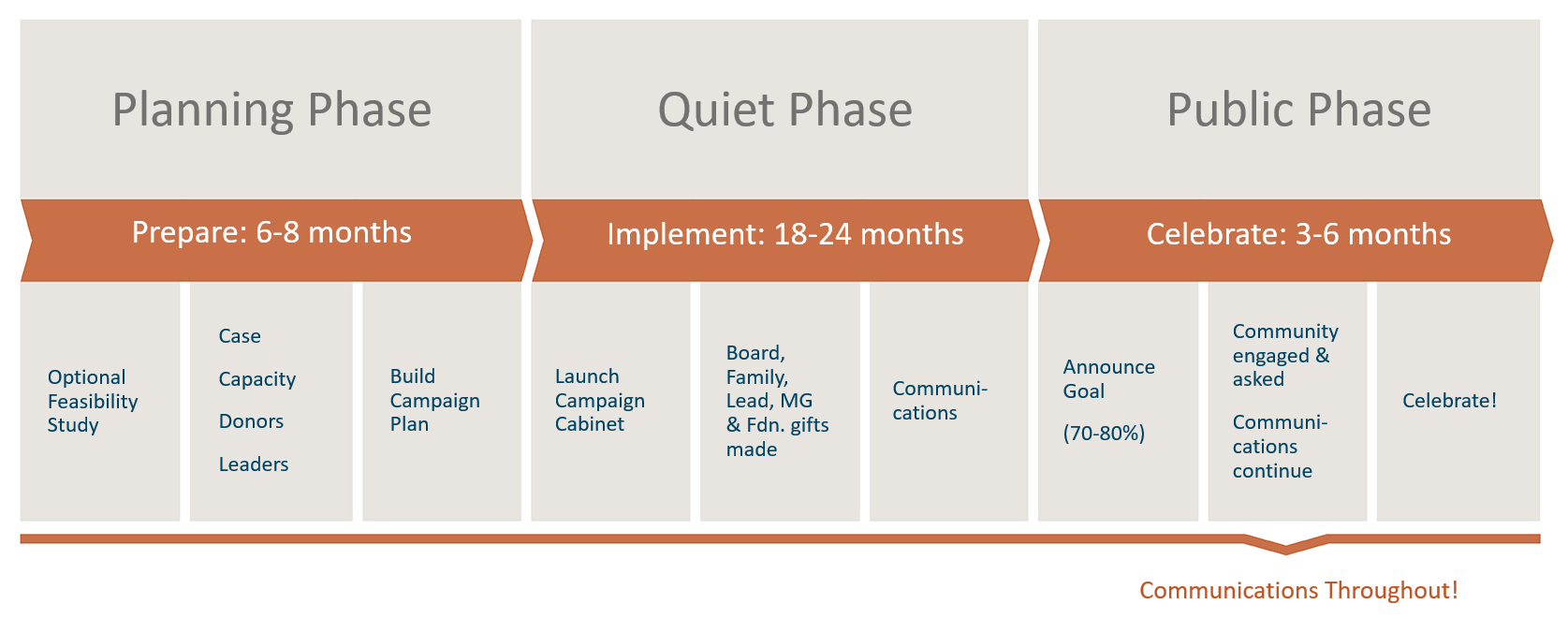
6. It helps to think of the campaign budget as a small percentage of the overall campaign goal. Campaign budgets (separate from the operating budget) generally include:
- Campaign staff salaries
- Travel
- Donor cultivation/events & meetings
- Donor database, office equipment
- Printing, marketing materials development, postage
- Donor recognition
- Campaign Counsel
7. Campaign leadership might be the most essential ingredient. Follow a process to enlist at least one or two campaign chairs, a campaign cabinet, and maybe include some honorary chairs:
-
- Identify: work with the campaign team and consultants to build a pool of potential campaign leaders
- Research: determine their experience, capacity, inclination, and availability
- Evaluate: prioritize top leader names, considering individuals, couples, parent/child pairings, etc.
- Educate: share the campaign goals and objectives with potential leaders
- Cultivate: build a trusted relationship from which to make an ask
- Enlist: ensure the right person is asking potential leaders to join the campaign team
8. Nonprofit staff is critical to keeping campaign momentum. Most campaigns employ a campaign coordinator role in addition to the organization’s current development team. The role of staff in a campaign is to be:
- prepared and organized
- sensitive to time constraints
- adaptable to leaders’ schedules
- responsive and supportive
- knowledgeable about relationships and contacts
- proactive in capturing all donor details and cultivation strategies in the database
9. Staff also help manage data and can work with the CRM and consultants to analyze and use data points such as wealth screening analytics.
Assemble all the ingredients and cover throughout with a dash of patience. Now you’re ready to heat up the oven and bake that campaign cake.
To tie it all together, consider gaining additional Campaign Baking Tips by attending one of CapDev’s well-known campaign planning workshops. Held twice a year at varying locations around the Carolinas, CapDev’s workshops help participants map out key steps and master the tools and resources needed to succeed in their next campaign.
CapDev workshops equip you with the knowledge and strategies to boost your campaign potential. Keep an eye on our website to deepen your expertise in the essentials of building and executing impactful campaigns.
Return to Insights & Events