
By Clare Jordan
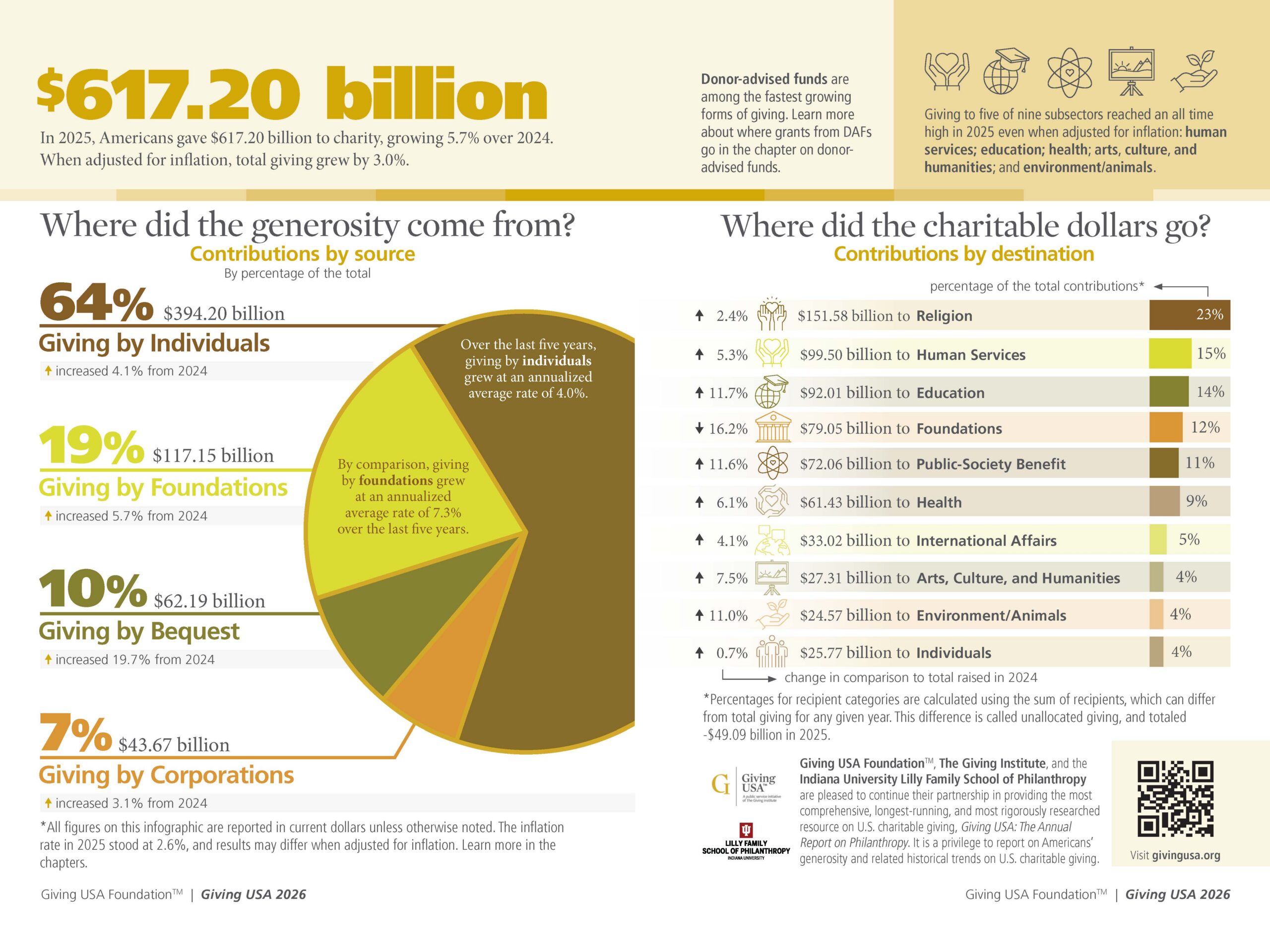
Americans are generous. According to Giving USA, we gave more to nonprofit causes last year than ever before ($617.2 billion). Yet, giving to the health sector has remained relatively flat in recent years.
What’s up?
Giving USA 2026 reported that the $61.43 billion in current dollars given in 2025 signals that giving to the health sector was relatively flat, growing just 0.3% in inflation-adjusted dollars between 2023 and 2025.
In the health sector, many of the largest major gifts funded new research capabilities, including work using AI and advanced analytics.
For example, Kinder Foundation gave $150 million to Texas Children’s Hospital and The University of Texas MD Anderson Cancer Center to launch a joint children’s cancer center. Gifts of this size can move the needle on overall giving data, but other sectors, such as human services and education, are realizing more of these mega-gifts in recent years.
Federal funding changes also impacted support for health research. By November 2025, the National Institutes of Health had frozen or terminated nearly 2,500 research grants with about $2.3 billion in unspent funds. Private philanthropy could not replace federal support at that scale.
What’s a healthcare-focused nonprofit to do?
As we see from an overall view of the national giving data, record giving alone cannot tell nonprofit leaders where philanthropy is headed, nor do data points give you the whole story. What can you do to buck the trends?
- Fill the gaps: When a major funding source changes, nonprofit leaders should identify which programs or priorities most depended on those dollars and where private support could help sustain mission delivery. Institutions can then build their case for support around those specific priorities, and development professionals can show donors how their gift can help as the organization adjusts its broader funding strategy.
- Expand the base: Health sector nonprofits would also be well advised to turn their attention toward building pipelines of next-generation donors. Click here to read more on this in a recent post by CapDev staffer, Stephanie Flores de Valgaz, who serves on the board of Novant Health Foundation in Winston-Salem NC.
- Build capacity: Adding MGOs to the development team of a healthcare organization is an investment in delivering your message. Throughout 2025, donors responded when organizations clearly communicated need, impact and opportunity.
- Demonstrate impact: Greensboro, NC based Cone Health Vice President & Chief Philanthropy Officer, Michelle Schneider, commented, “In an environment of relatively flat philanthropic growth, our ability to consistently secure $10 million to $12 million annually over the past five years is a testament to our focus. This success reaffirms that health remains a critical priority, that deep relationships drive sustained giving, and that major donors are looking for true impact. Our core work hasn’t changed; it simply demands continued discipline and relentless optimism.”
- Focus on key relationships: Appalachian Regional Health Foundation President, Rob Hudspeth, noted, “While many people contribute to our foundation, we are still in a situation where 10% of our donor base makes up 90% of our total giving. Our focus has really been on cultivating deep, ongoing relationships with those key stakeholders in order to shift philanthropy into a long-term partnership where donors feel valued and personally connected to our mission. When donors feel connected, they continue to support us and are passionate about connecting us to others in their circle of influence.”
Capital Development Services has always asserted that both the science (trend tracking, moves management, data analytics…) and the art of relationship building must be combined to successfully attract and retain critical donor relationships. Balancing the formula could influence a shift in this trend and build support for healthcare at a time when it is most needed.
Return to Insights & Events